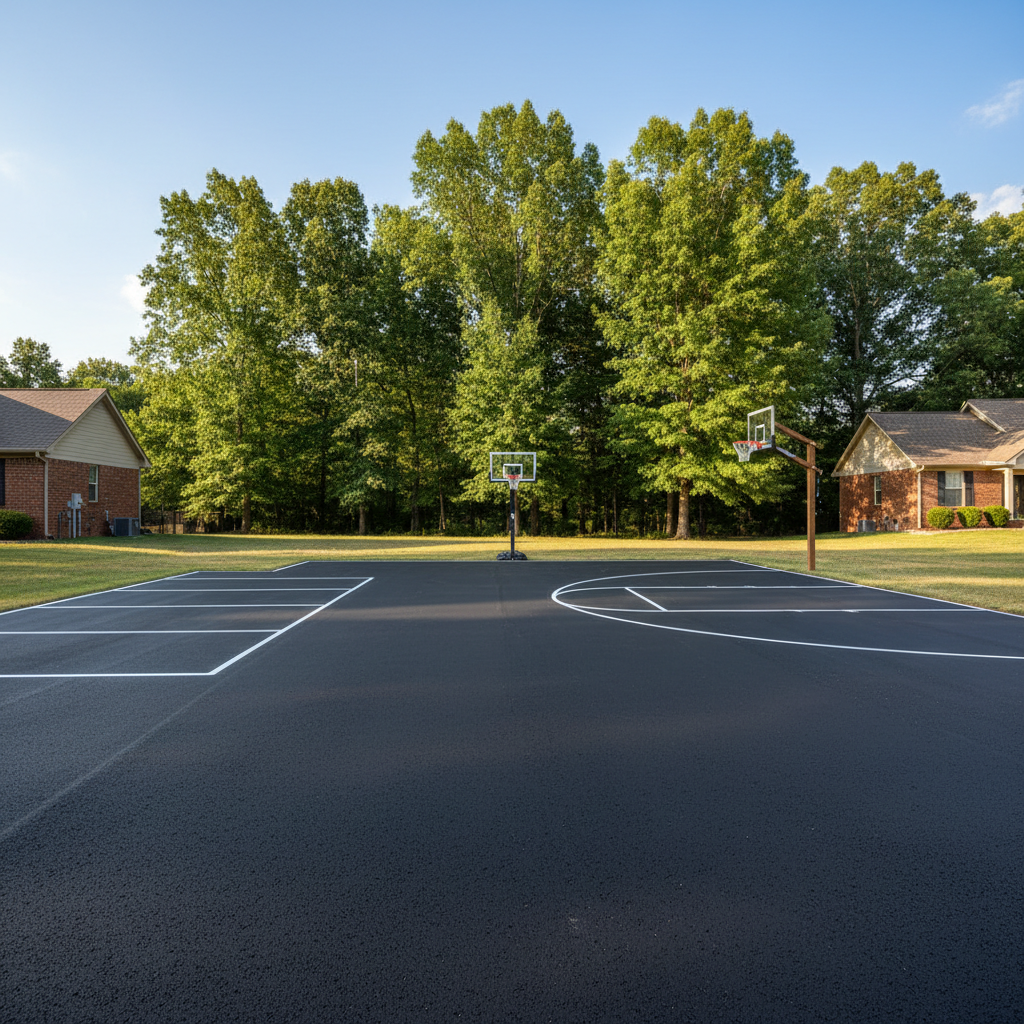
Alright, let's talk about asphalt striping for your home. You might think it's just a few lines of paint, right? How hard can it be? Well, I'm here to tell you that while the concept is simple, the execution and planning can go sideways fast if you're not careful. I've been doing this for years here in Springdale, and I've seen pretty much every mistake in the book. You want to avoid regret? Pay attention.
Mistake #1: Not Knowing What You Actually Need
This is probably the biggest one. A lot of folks call us up and say, "I need my driveway striped." But what does that really mean for your home? Are you talking about parking spaces for a multi-car household? A basketball court? A clear path to your garage? Maybe you're trying to define boundaries on a shared driveway, which is common in some of the older, tighter neighborhoods around downtown Springdale.
Before you even pick up the phone, sit down and sketch out what you want. Think about how you use your space. How many cars do you park? Do you need a turnaround area? Are there kids who play in the driveway? Having a clear vision helps me give you an accurate quote and ensures you get what you're paying for. If you just say "stripe it," you're leaving too much up to interpretation, and that's how you end up with something that doesn't quite work.
Mistake #2: Going for the Absolute Cheapest Bid
Look, I get it. Money doesn't grow on trees, especially not here in Northwest Arkansas. Everyone wants a good deal. But when it comes to asphalt striping, the cheapest bid is almost never the best bid. I've seen it time and again where a homeowner goes with the lowest price, and then they're calling us a year later because the lines are faded, peeling, or just plain crooked.
Why does this happen? Usually, it's one of a few things:
- Cheap paint: Some contractors use low-grade traffic paint that isn't designed to hold up to UV rays, tire wear, or our sometimes brutal Springdale weather. You need durable, high-quality material.
- Poor prep: You can't just slap paint on a dirty, dusty surface. The area needs to be cleaned thoroughly, sometimes even primed, for the paint to adhere properly. Cutting corners here means early failure.
- Lack of experience: Striping isn't just about painting straight lines. It's about proper spacing, appropriate line widths, and understanding how vehicles will use the space. An inexperienced crew can make a mess of it fast.
Always ask what kind of paint they use and what their process is. A reputable company like Omega Paving Solutions will be transparent about their materials and methods.
Mistake #3: Not Checking References or Insurance
This one's a no-brainer for any home improvement project, but people still skip it. You're letting someone work on your property. You need to know they're legitimate and protected.
Ask for references. Call them. Ask about their experience, their professionalism, and if they finished on time and on budget. And for crying out loud, ask for proof of insurance. If a worker gets hurt on your property and the contractor isn't insured, guess who could be on the hook? You. It's a risk you absolutely don't need to take.
Mistake #4: Ignoring the Weather (or the Contractor Who Does)
Our weather here in Springdale can be unpredictable. One day it's sunny and 70, the next it's raining or freezing. Striping needs specific conditions to cure properly. If it's too cold, too humid, or if rain is on the way, the paint won't adhere right or will wash away. A good contractor will factor this in and won't try to rush a job when conditions aren't ideal. If someone's pushing to stripe your driveway when the forecast looks iffy, that's a red flag. You want those lines to last, and that means respecting the elements.
Mistake #5: Not Getting Everything in Writing
Verbal agreements are nice, but they don't hold up when there's a disagreement. Get a detailed quote or contract that outlines everything: the scope of work, the type of paint, the number of lines, the dimensions, the timeline, and the total cost. This protects both you and the contractor. If something isn't clear, ask questions until it is. Don't sign anything you don't fully understand.
Avoiding these common missteps will save you headaches, money, and frustration down the road. Do your homework, ask the right questions, and choose a contractor who knows what they're doing. You'll be much happier with the end result, trust me on that one.